up to €6,000
For an inaccessible service or missing information
If you do not make the service accessible or do not publish the required information about its accessibility.
Do you run a company website or e-shop?
Legible type, sufficient contrast and the option to enlarge content are a legal requirement for selected e-shops and online services. Check whether the obligation applies to your company too.
Don’t risk a fine. Have your website checked.
At ABC Design, we check your website’s accessibility, fix the errors we find and prepare the documents you need in case of an inspection.

If your service falls under Act No. 351/2022 Coll. and you have no exemption, you have had to meet these obligations as well since 28 June 2025:
If the service does not meet the requirements, you must notify the competent supervisory authority and take corrective action. During an inspection, you must provide the requested documents and cooperate. Obligations under Section 6 of the Act (in Slovak).
If the Act applies to your service, the Slovak Trade Inspection (SOI) can also follow up on a customer complaint and request documentation. The amount of the fine depends on which obligation was breached.
up to €6,000
If you do not make the service accessible or do not publish the required information about its accessibility.
up to €20,000
If you do not put procedures in place to keep the service accessible, do not report non-compliance to the supervisory authority or do not take the corrective action the law requires.
up to €30,000
If you do not give the supervisory authority the requested information, documentation or the necessary cooperation.
The Act sets a fine from €200 up to 3% of turnover for the previous accounting period, but no more than the relevant cap above. It also covers cases where a fine may be waived. Source: Section 10 of Act No. 351/2022 Coll. (in Slovak)
The SOI can request documents and cooperation. If non-compliance is found, the law requires you to report it and take corrective action. That is another reason to know the state of your website and deal with shortcomings in advance.
Do you run any of these services for consumers, meaning people buying for personal use? Then the Act may apply to you. Find your activity, then check the small-business exemption below.
You sell clothing, furniture, electronics, food or other goods to ordinary customers online. The rules can also cover an e-shop selling second-hand or vintage goods.
Your website lets people book a stay, a room or a holiday. Online sales and bookings that lead to a contract with a consumer are among the services where accessibility needs to be checked.
You sell tickets for the cinema, concerts or events online. Or your website lets customers order a course or another service for personal use.
You provide consumers with loans, payment services, payment account services, electronic money or investment services as defined by law.
You run a website, an app, electronic ticket sales or passenger information for air, bus, rail or waterborne passenger transport.
You provide e-books or dedicated software that customers use to open, browse and read them.
There is an exemption in transport: for urban, suburban and regional transport, websites, apps, electronic tickets and travel information are excluded from this regime. Interactive self-service terminals are assessed separately.
Telecommunications, television and public administration: electronic communications services, access to audiovisual media services and public sector websites are governed by other regulations. Their obligations are assessed separately.
A website that introduces your company, shows your work and gives contact details does not automatically fall under this obligation. Nor does selling only to businesses. What matters is whether you provide consumers with one of the services the Act covers.
Having 10 employees or a turnover above 2 million euros is not enough on its own. The conditions on the type of service and on providing it to consumers must be met first.
For services, the Act leaves out microenterprises. But turnover alone does not decide it. The number of people and at least one of two financial indicators are assessed.
Yes. You count them according to how much and how long they work. The microenterprise exemption uses an annual conversion: one person working full time for the whole year equals one annual work unit (AWU).
Full time for the whole year.
Half time for the whole year.
Half time for six months.
Example: 8 people working full time for the whole year and 4 temporary staff working half time for six months add up to 9 AWU. This holds if no other people or other enterprises need to be included in the calculation.
Working owners and partners: include owners who run the business and partners who work in it regularly and benefit from it financially. You do not automatically add an independent external contractor; what matters is their actual relationship with the company.
Student jobs and vocational training: a standard student temporary work agreement counts. The exception covers apprentices and students in vocational training under the relevant contract. Being a student is not enough on its own. Maternity and parental leave are not included in the conversion.
Accounting periods and linked companies: the calculation is based on the last approved accounting period. If you go above or below the limits, two consecutive accounting periods are usually assessed. The rules for new, partner and linked enterprises must also be taken into account. If the result is borderline, have the calculation checked by an accountant or a lawyer.
The interpretation for work agreements is based on the definition of staff in Article 5 of the annex to Recommendation 2003/361/EC and the status of an employee under the Slovak Labour Code (Section 11 and Sections 223 to 228a, in Slovak).
An exemption can apply to specific content or a specific requirement. It does not necessarily release the whole website from its obligations.
Services under contracts concluded by 28 June 2025 are covered by a transitional rule until the contract ends, and no later than 28 June 2030. This is not a general deadline extension for old e-shops.
Pre-recorded video and audio and office files published before 28 June 2025 are also exempt. The Act also leaves out archives whose content is not edited or updated after that date.
For online maps intended for navigation, the essential information must also be available in an accessible digital form. For third-party content, it depends on how it was created, how it is funded and its relationship to the service provider under Section 2(2)(b).
Using someone else’s plugin or payment gateway is not, in itself, a general exemption for your website or the whole order process.
The requirements apply to the extent that they do not change the basic nature of the service or, under the legal criteria, do not impose a disproportionate burden. Saying that a fix is expensive or technically difficult is not enough.
An assessment must be prepared, its result kept for five years after the service was last provided, and the use of the exemption reported to the competent supervisory authority. For a disproportionate burden, the assessment must be renewed when the service changes, at the supervisory authority’s request and every five years. If you receive external funding intended to improve accessibility, you cannot use the disproportionate burden exemption.
Scope and exemptions: Sections 2, 7 and 12 of Act No. 351/2022 Coll. (in Slovak)
We find out which requirements the website does not meet. We agree the scope of fixes, test the changes and hand over the documentation. You will know what has been resolved and what still needs to be done.

We check key pages, forms and the purchase process. We back up automated tests with manual testing using the keyboard, a screen reader and enlarged content.
For you: You have the state of your website documented and a plan to fix it. You know which shortcomings to remove and what work to order.
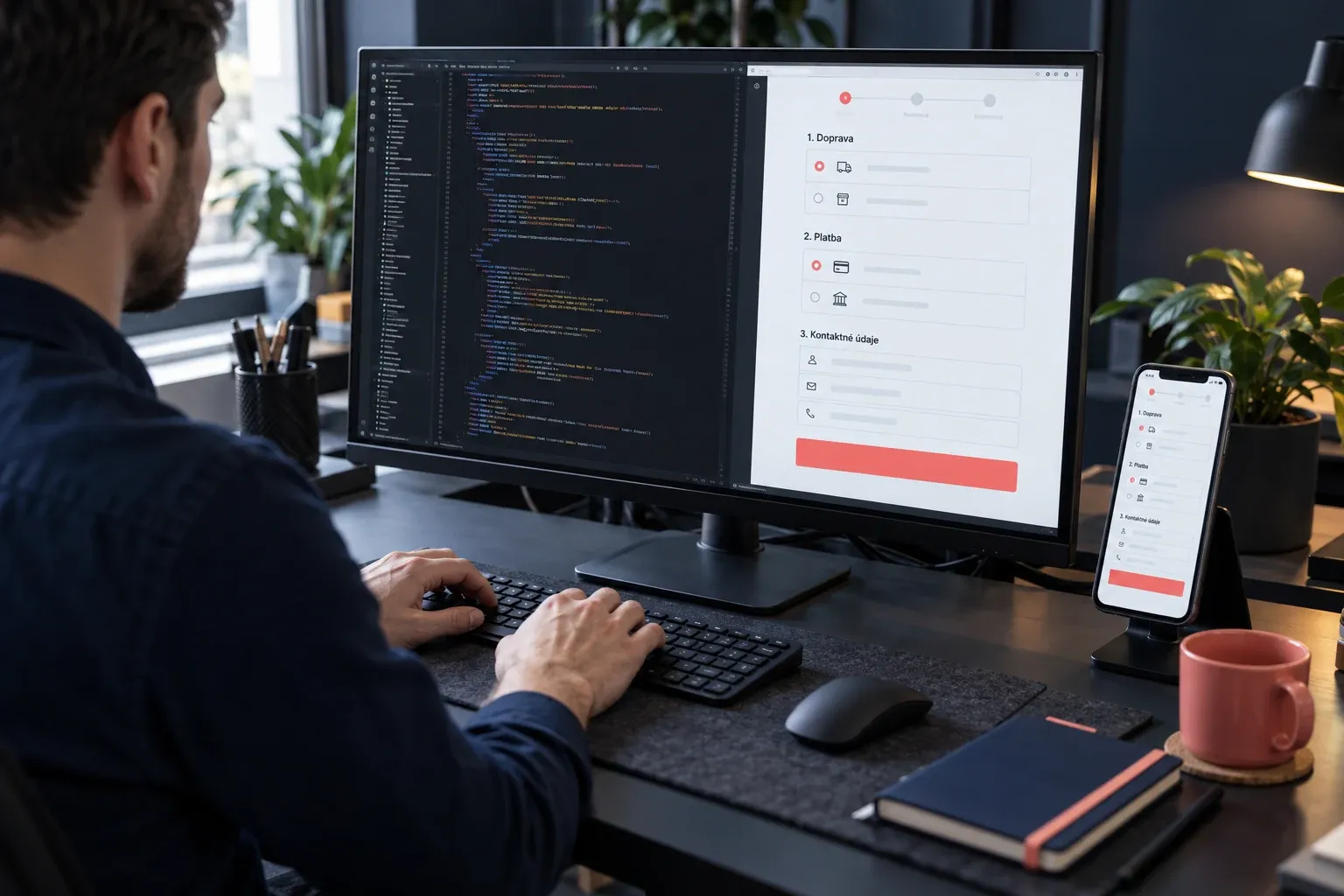
We improve keyboard navigation, legibility, button names, page structure and error messages. Then we test the fixed areas again, along with the related steps.
For you: You get an overview of the shortcomings removed and the results of the retest. Where the system itself is the limit, we tell you what needs to be resolved with your supplier.

We hand over the audit results, a list of fixes and the results of the retests. We prepare technical input for the mandatory information on the service’s accessibility, and rules for future changes to the website.
For you: In an inspection, you have something to show: the documented state of the website, the work done and the remaining tasks. Your team knows what to keep checking.
Choose based on who will remove the shortcomings. Either way, we agree the scope of the check and what you will receive in advance.
If you have your own developer
You learn the state of your website and your team gets specific tasks.
We can include a retest after the changes in the quote.
I want an audit quoteIf you want us to make the changes
ABC Design takes care of both the website check and the agreed technical changes.
The price of the audit depends on the number of page types, forms and checkout steps, and on the system used. We specify the price of fixes based on the findings. You approve the scope and price before any work starts.
Here are three examples of problems we check in the basket, in forms and with a screen reader.
Where should we deliver your order?
Tab move between elements · Enter confirm
When using a keyboard, the active element has no visible highlight. The customer has to guess which delivery option they are on.
We add a visible highlight, the correct order of elements and full control without a mouse.
We test the whole path from the basket to payment.
Where should we send the confirmation?
Email (required)
Enter your full email address, for example jana@email.com.
The error is explained in text and the field is marked.
The form marks the error with colour only. The customer never finds out why they can’t continue.
We add a specific instruction, link it to the field and make sure the screen reader announces the error.
We test both invalid and valid input.
Table lamp
“Add table lamp to basket, button.”
The name explains the action without having to see the icon.
The basket button has no accessible name. The screen reader just says “button”, and the customer doesn’t know what will happen.
We add a clear name and an announcement that the product has been added to the basket.
We test choosing the product and the confirmation of the action.
An automated tool helps uncover some of the problems. A score on its own does not confirm that the whole service is accessible.
I want an audit of my website
The changes help you meet a legal obligation and remove obstacles to buying at the same time. More legible text, a clear form and control without a mouse make it easier for customers to complete their order.
Which companies the Act applies to, whether adapting your existing website is enough and how we set the price.
WCAG is a technical standard, not the name of a law. In Slovakia, what matters for these services is Act No. 351/2022 Coll. and Government Regulation No. 283/2023 Coll., based on European Directive 2019/882.
For the audit, we agree a technical target, for example WCAG 2.2 level AA, and the relevant requirements. Meeting the WCAG checklist alone does not automatically mean all legal obligations are met.
Turnover alone does not settle it. With fewer than 10 people after the annual conversion of work, an annual turnover or an annual balance sheet total of no more than 2 million euros meets the financial condition for a microenterprise. However, the rules on calculation, accounting periods and links to other enterprises also apply.
The exemption applies to services provided by microenterprises. Whether the Act applies is always assessed for the specific service as well.
Yes, if you provide a service covered by the Act through it and have no exemption. Even an e-shop launched in, say, 2015 that still takes orders from consumers is assessed under the rules in force since 28 June 2025.
2030 is not a general deadline extension for older websites. Section 12 deals with specific contracts concluded earlier, and separately with older videos, office files and archives that are no longer edited.
No. The Act allows the supervisory authority to impose a fine and distinguishes between the obligations breached. Where the obligation to make the service accessible or to put procedures in place to stay compliant is not met, Section 10(3) allows the fine to be waived if the provider takes the corrective action required by law or proves the conditions under Section 7(1).
This is not a general exemption for every shortcoming. That is why it makes sense to know the state of your website, fix the errors found and keep the documents.
A plugin can help with some settings. On its own, though, it does not check whether an order can be completed with a keyboard, whether a screen reader understands the form or whether an error message is clear. That is why we check and fix the website itself and how it behaves.
Not necessarily. First, we check what your existing system allows. Some problems can be solved by adjusting the template, content or components. If the system limits a fix, we explain the specific reason and your options.
The price depends on the number of page types, forms and checkout steps, and on the system used. Send us your website address. We first propose the scope of the audit; we specify the price of fixes based on the findings.
Legal content verified as at 15 October 2026. The scope of obligations and exemptions depends on the specific service and the circumstances of the business; this page is a general overview.
Send us your website address and briefly describe what you sell through it. We will prepare a quote for the audit, the necessary changes and the documentation.
You can also contact us if you only want an audit or a brief for your own developer.